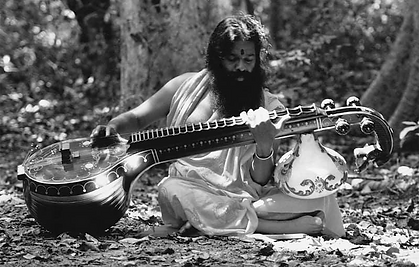
The sounds and music of Sri Swamiji
Sri Ganapathy Sachchidananda Swamiji possessed a deep understanding of the ancient musical system of "Raga Ragini," and with an unparalleled passion for melody, he created numerous new ragas (melodies) using the ancient system within the framework of modern musicology. Due to Sri Swamiji's prolific output, the title "Sagara (Sea)" was chosen to represent this form of Raga Ragini. Sri Swamiji is known for his numerous charitable activities and for reviving the ancient musical system of "Raga Ragini." Furthermore, his music is "Nada Yoga (Yoga of Sound)" and is deeply connected to the yogic process.
Rāga
That which colors the mind is Rāga
Rāga is a combination of notes and melodic forms, and the rāginī is the melodic foundation for improvisation. Indian music is based on rhythm and melody, rather than on the fundamental elements of Western music such as chords, harmonies, and counterpoint. The raga is the framework that serves as the standard for improvisation. While following the guidelines of the rāga, each performance becomes unique through improvisation. The word rāga comes from the Sanskrit word "rañj" (to color). A rāga is like a musical mode with specific characteristics. It is a combination of ascending and descending scales with distinctive nuances. The notes that make up a raga are not always seven, and the arrangement of notes may not be regular. For example, there may be a scale that omits the note A, or the arrangement of notes may be zigzag. Also, the ascending and descending scales may be different. The characteristics of the mode form an extended melody called a chalan. The musician first learns the chalan (the progression of the rāga), and then their creativity shines through in the manodharma sangeetham (improvisation). The rāga is performed with creative freedom while preserving the bhāva (emotional expression) of the rāga.
Each rāga potentially has the power to influence specific ailments. Every rāga and all of nature's products, such as plants, herbs, minerals, gemstones, and colors, has a specific rāga, and when combined with its energy vibrations, it creates a flow that brings about a greater influence.
Nāda
The whole world is filled with Nāda.
Nāda means "sound," "vibration," or "resonance," representing the fundamental vibrations of the universe and the sound of inner consciousness. Physical sound is one manifestation of this Nāda. In the scriptures, the creator of the universe (Nāda Brahman) is also defined as a personification of Nāda.
There are two types of Nāda: "Āhata Nada" and "Anāhata Nāda".
"Āhata Nāda" is audible, obvious, and physical sound energy. "Anāhata Nāda" is inaudible, hidden, subtle, and metaphysical sound energy.
Sri Swamiji states that Nada Chikitsa (music therapy) is a yogic process. It is not simply a musical performance or concert. To understand it, one needs to understand the chakras (energy centers in the body), nādis (subtle energy pathways), the nervous system, endocrine glands, and the effects of musical sounds on each of these parts.